
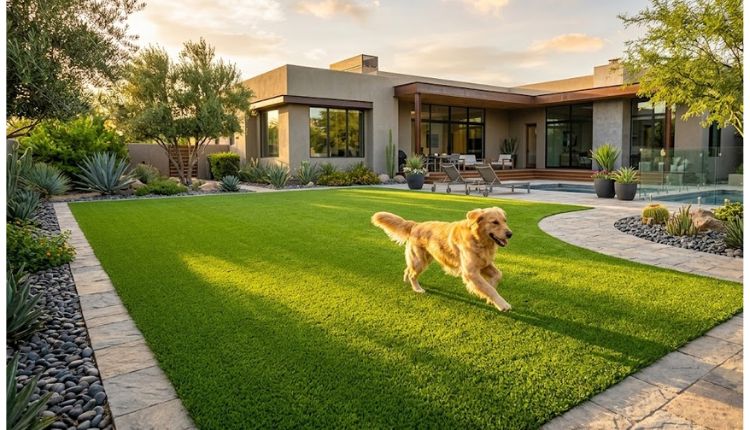
Kansas City homeowners invest seriously in their properties. Overland Park, Lenexa, Olathe, Shawnee, and the neighborhoods spreading south through Johnson County are full of homes with well-maintained yards and decks built for the way people in this region genuinely like to spend time outside. The problem isn’t motivation. The problem is that a handful of high-impact upgrades keep getting pushed to next season’s list while the backyard keeps underperforming in predictable ways year after year.
These aren’t outdoor additions that require tearing anything out or starting from scratch. Most of them work with what’s already there.
1. A Hardscaped Patio That Doesn’t Shift, Sink, or Drain Poorly
A lot of Kansas City backyards are sitting on poured concrete slabs or basic paver setups that were either installed cheaply or have simply aged past the point of looking good. Cracked concrete, uneven pavers, and surfaces that pond water after every rain are the kind of problems homeowners learn to tolerate because replacing the patio feels like a large commitment. The reality is that a properly graded and installed hardscape surface is the foundation everything else in the backyard builds on, and fixing it correctly is meaningfully less expensive than managing drainage problems that compound over years.
Natural stone, porcelain pavers, and concrete with intentional banding or texture have all become more accessible in the Kansas City market over the last several years, and the visual difference between a well-laid paver patio and a cracked slab is significant enough that most homeowners consider it one of the higher-return projects they’ve completed on the property.
2. Landscape Lighting That Makes the Backyard Usable After Sunset
Most Kansas City backyards go dark around 8 p.m. and stay that way. Low-voltage path lighting along beds and walkways, uplighting on mature trees, and string lighting across a pergola or fence line are all installations a landscape lighting contractor can complete in a single day, and the effect is a backyard that reads as finished and intentional at every hour rather than shutting down visually the moment the sun drops.
The work doesn’t require a significant electrical project, and for homeowners who consistently find themselves wrapping up evenings earlier than they’d like because the yard gets too dark to be comfortable, this is one of the faster fixes on the list.
3. A Pergola With a Real Roof
A freestanding pergola with open lattice overhead is a reasonable starting point, but it doesn’t solve the core problem of a Kansas City summer afternoon, which is direct sun and the very real possibility of a storm rolling through mid-gathering. Louvered pergola systems, which allow the roof slats to open and close depending on conditions, have come down significantly in price and are now installed regularly throughout Johnson County neighborhoods that would have considered them a luxury purchase five years ago.
The functional difference between a standard open pergola and a louvered system is substantial. A louvered roof closes when rain arrives and opens fully when conditions are clear, which means the covered area beneath it stays usable across a much wider range of weather than a fixed lattice roof ever could. Motorized versions can be controlled from a phone, and most systems integrate cleanly with ceiling fans, lighting, and privacy screens.
For homeowners who’ve already built a pergola and found that it doesn’t do as much weather work as they hoped, a louvered roof panel retrofit is often available as an upgrade without replacing the entire structure. That makes it one of the more accessible improvements on this list for anyone who already has something to work with.
4. Finishing the Space Below an Elevated Deck
Elevated decks are common throughout the Kansas City metro, and the space directly beneath them is almost universally ignored. It doesn’t show up in remodeling budgets, it doesn’t get mentioned during deck installations, and most homeowners don’t think seriously about it until they’re standing on the upper deck during a rainstorm watching a perfectly covered lower level function as storage for things that should have been thrown away two summers ago.
The covered lower level beneath an elevated deck is often the largest naturally shaded area on the entire property. In Kansas City neighborhoods where lots step down from the house or where walkout lower levels create eight or more feet of clearance, that space is a full-height room waiting to be finished. Anunder-deck ceiling system channels water away from the surface below, eliminates the visual disorder of exposed joists and hanging wires, and converts the lower level from a drainage problem into a covered patio that stays dry regardless of what’s happening overhead.
Most homeowners who finish the space with under decking report that it becomes the most consistently used part of the backyard within a season, particularly during the summer months when the upper deck is too hot to use for most of the day.
5. An Outdoor Kitchen Built for How Grilling Actually Works
A freestanding grill on a deck is a starting point, not a destination. Homeowners who cook outside regularly know that a standalone grill with no counter space, no storage, and no sink creates a constant back-and-forth to the kitchen that takes the host out of the gathering more than it should. A built-in outdoor kitchen with a grill, side burner, refrigerator, and countertop space consolidates the cooking process in one place and makes the backyard function more like a room where hosting actually happens.
A ten-foot run of countertop with an integrated grill, undercounter refrigerator, and a small sink handles most of what a weekend host actually needs, and Kansas City contractors build these at a wide range of price points depending on materials and appliance selections. Stucco, stone veneer, and concrete board are all common finish materials in the local market and hold up well against the freeze-thaw cycle that eliminates some options available in warmer climates.
6. A Fire Feature That Extends the Season on Both Ends
A well-placed fire feature extends the functional season of a Kansas City backyard by at least two months in each direction, and built-in fire pit surrounds with integrated seating walls are a common project throughout Johnson County that produces a natural gathering point making the backyard feel designed rather than assembled. Stone or concrete cap materials retain heat in a way that makes cool-weather evenings genuinely comfortable well into October and again from late March onward. Gas fire pits light immediately, require no ash management, and can be shut off without waiting for coals to cool, which makes them the practical choice for most homeowners even if the wood-burning option remains appealing on paper. For Kansas City homeowners who find that the backyard shuts down from November through April, a fire feature paired with a covered structure above is often what finally changes that habit.
None of these projects require rebuilding the backyard from the ground up, and most are within reach for homeowners who’ve been putting off the decision because a full renovation felt too large to tackle at once. The Johnson County and Kansas City Missouri markets have enough contractors working in each of these categories that getting competitive estimates is straightforward. Starting with one project typically makes the next one easier to justify once the backyard starts performing the way it should.
