
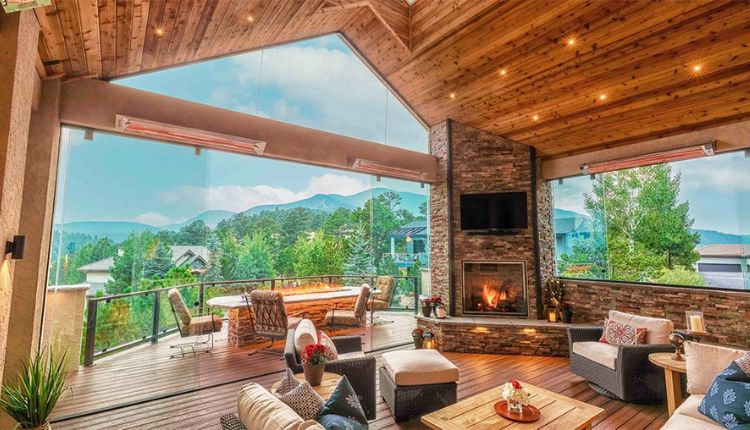
Every region develops its own architectural accent over time.
New England has weathered fieldstone walls, cedar shingles, and fireplaces that feel as though they’ve been standing since the Revolutionary War. The Pacific Northwest leans into timber, steel, and natural materials that blur the line between the home and the forest beyond it. The Southwest embraces stucco, adobe influences, and earthy tones that mirror the surrounding desert. Spend enough time studying homes across the country and patterns begin to emerge. Materials become shorthand for place. They tell you where you are before anyone says a word.
Colorado occupies a fascinating middle ground. Its outdoor living spaces borrow from mountain lodges, luxury resorts, and the kind of rugged landscapes that have made the state an architectural reference point for decades. The result is an outdoor fireplace scene that feels distinctly its own, less preoccupied with trends than many coastal markets, and more focused on permanence, gathering, and creating features that seem to belong to the land rather than having been placed on top of it. There is an expectation that outdoor spaces should feel substantial here. A fireplace is not merely decorative. It is often the anchor around which evenings unfold, conversations linger, and the backyard transforms from a patch of land into a destination.
To better understand what defines Colorado’s outdoor fireplace aesthetic, we dug through design guides, contractor portfolios, luxury mountain home projects, Pinterest boards, and emerging outdoor living trends. If you’re considering adding a fireplace or fire feature to your backyard, these are the materials and styles shaping Colorado’s outdoor living scene right now.
1. Natural Stone Fireplaces: Colorado’s Signature Statement
If one material defines Colorado’s outdoor fireplace landscape, it’s natural stone.
When your state contains some of the most dramatic mountain scenery in North America, homeowners gravitate toward materials that feel connected to that environment. Stone fireplaces often appear less like additions and more like extensions of the surrounding landscape, features that seem to have been there before the house was built rather than after. Large moss rock boulders, natural flagstone, sandstone, and weathered granite are used to create fireplaces that feel rooted in place. Unlike manufactured veneer products, natural stone introduces genuine variation in texture, color, and character. No two installations look exactly alike, and that distinction is precisely the point. The slight imperfections, shifts in coloration, and evidence of geological history give each fireplace a sense of authenticity that manufactured materials often struggle to replicate.
The appeal goes beyond aesthetics. Stone ages well. It handles Colorado’s freeze-thaw cycles with very little compromise. It pairs with mountain contemporary homes, traditional ranch properties, and most architectural styles in between.
Above all, it carries a sense of permanence that most other materials simply don’t. A well-built stone fireplace often feels less like a project and more like an investment in the long-term character of a property.
2. Moss Rock: The Material That Looks Like It Has Always Been There
Within Colorado’s broader stone category, moss rock earns its own discussion.
Few materials create the same sense of geological continuity. The weathered surfaces, subtle coloration, and organic textures found in moss rock can make a newly installed fireplace appear decades older than it is. Rather than looking constructed, it feels found. That quality explains why moss rock remains a consistent presence throughout luxury mountain communities like Vail, Breckenridge, Steamboat Springs, and Estes Park. Homeowners aren’t simply selecting a building material. They’re selecting a feeling. Moss rock carries the visual memory of Colorado itself, echoing the boulder fields, mountain outcroppings, and weathered formations people encounter while exploring the state’s trails, forests, and high-country landscapes.
Unlike highly refined materials that can feel disconnected from their surroundings, moss rock tends to settle naturally into the landscape. It softens the transition between architecture and nature, helping the fireplace feel like part of a larger environment rather than a standalone feature.
That ability to bridge the built and natural worlds is one reason moss rock continues to outperform trendier materials. Design styles evolve. Color palettes shift. Entire architectural movements rise and fall. Moss rock remains remarkably resilient because it isn’t responding to fashion. It is responding to place. For homeowners who want a fire feature that feels authentic rather than assembled, it remains one of the most compelling options available. It is also one of the reasons homeowners and contractors continue turning to suppliers like The Rock Garden when searching for materials that capture Colorado’s distinctive outdoor aesthetic.
3. The Return of the Conversation Pit
Some design ideas are worth revisiting.
Conversation pits became popular in the 1960s and 1970s before fading from residential design. Today they’re reappearing in a form that shares the original concept’s intent while leaving behind its dated execution.
The modern version lives outdoors. A fire feature serves as the centerpiece, surrounded by built-in seating, natural stone walls, layered lighting, and furnishings that invite extended use. The emphasis is on connection. People face one another rather than a screen, and the fire becomes the focal point around which conversation unfolds at its own pace.
What makes the modern conversation pit particularly interesting is that it reflects a broader shift happening in outdoor living design. Homeowners increasingly want their backyards to function like additional rooms rather than occasional-use spaces. Designers are responding by creating outdoor environments that encourage lingering. The fireplace or fire pit serves as the gravitational center, drawing people together much the way a kitchen island tends to do indoors.
Colorado homeowners have embraced this because outdoor living here is rarely treated as a seasonal activity. A well-designed fire feature extends patio use well into fall and through a surprising number of winter evenings. The conversation pit, in that sense, isn’t about nostalgia. It’s about creating a place within the backyard that people actually want to return to.
4. Brick Fireplaces: Enduringly Dependable
Brick doesn’t generate the same attention as natural stone, but its staying power deserves recognition.
Certain materials behave like a well-tailored garment. They don’t chase headlines, but they don’t disappear from rotation either. Brick is one of them. Traditional red brick carries warmth and familiarity. Whitewashed brick reads softer and more contemporary. Dark brick introduces sophistication and contrast against lighter architectural elements. Part of brick’s durability as a design choice comes from its versatility. It pairs well with traditional homes, farmhouses, transitional architecture, and a wide range of modern designs. It also develops character as it ages rather than simply showing wear. Stone may earn more attention in Colorado’s outdoor living spaces, but brick has served as one of the most dependable fireplace materials in the country for generations, and that hasn’t changed.
While brick may not always be the star of the show, it often becomes the material homeowners appreciate more as the years pass. Its familiarity is part of its appeal.
5. Tile Fireplaces: A Colorado Aesthetic on Its Own Terms
Colorado’s design scene has grown considerably more diverse over the past decade, and not every homeowner arriving here has come to recreate the mountain lodge aesthetic. For those who’ve forged their own definition of what a Colorado outdoor fireplace can look like, one less shaped by the surrounding landscape and more by personal design conviction, tile has become an increasingly popular choice.
Large-format porcelain tile, textured ceramic, and natural stone tile are being used to create fireplace surrounds with clean geometry and strong visual presence. The result can feel polished without becoming sterile, and it opens up a range of customization that natural stone doesn’t always allow.
The most successful tile installations balance contemporary materials with natural elements like wood, stone, and surrounding landscaping, grounding the feature in its environment even when the design itself departs from convention.
6. Steel and Stone Combinations
Some of Colorado’s most striking outdoor fireplaces are built from materials that seem to have little in common.
Steel introduces precision. Stone introduces organic variation. Together, they create a contrast that tends to produce something more compelling than either material achieves on its own. Powder-coated steel surrounds, corten steel accents, and custom metal hearth features are increasingly appearing alongside natural stone installations. The pairing works especially well in mountain contemporary homes where the goal is to balance ruggedness and refinement without sacrificing either. The stone absorbs the steel’s sharpness. The steel gives the stone’s informality a defined edge. Neither material dominates the composition. Instead, each material highlights the strengths of the other. The result often feels sophisticated without becoming cold, modern without feeling disconnected from the landscape that inspired it.
The combination has become especially popular among architects who want to create fireplaces that feel current while still honoring Colorado’s natural surroundings.
7. Boulder Fireplaces and Fire Features
One trend gaining real momentum throughout Colorado involves using massive natural boulders as structural elements within fireplaces and fire features. Rather than cutting stone into uniform shapes and laying it in courses, designers are allowing the natural forms to remain largely intact.
The result is often sculptural in a way that conventional masonry can’t achieve. These installations blur the line between landscaping and architecture, producing fire features that read as part monument and part hearth. In some of the more ambitious examples, the surrounding patio appears to have been built around an existing rock formation, a deliberate illusion that requires considerable planning to execute convincingly. What makes these installations so compelling is that they feel uniquely tied to Colorado. They echo the dramatic geological formations that define so much of the state’s scenery and create focal points that feel impossible to duplicate elsewhere.
This approach produces fireplaces that often become the defining visual feature of the entire backyard.
Defining Colorado’s Fireplace Style
If one theme runs through Colorado’s outdoor fireplace scene, it’s a preference for materials that feel substantial and considered. Stone, moss rock, brick, steel, tile, and natural boulders all play meaningful roles, but the underlying goal tends to be consistent. People want outdoor spaces that feel grounded in something real, whether that means the surrounding landscape or a clear personal design vision.
Colorado’s aesthetic has historically rewarded permanence over novelty. The outdoor fireplaces that hold up best over time, both structurally and visually, tend to be the ones that look as though they were always meant to be exactly where they are. That may be the most defining characteristic of Colorado design. Rather than chasing what is new, it tends to celebrate what feels lasting. Homeowners want spaces that will still look appropriate ten or twenty years from now, and the materials chosen for outdoor fireplaces often reflect that mindset.
That’s a harder thing to achieve than it sounds. When a fireplace gets there, though, it stops being a backyard feature and starts being the place where the seasons are extended, the stories accumulate, and the back of the property becomes somewhere worth being.
